
Kabaddi
India's Unfinished Ledger on the Kabaddi Mat: The Defensive Gap Before Asian Games 2026
মূল উত্তর: এশিয়ান Games ২০২৬-এর চতুর্থ দিনে ভারতের পুরুষ কাবাডি দল বাংলাদেশকে হারিয়ে সেমিফাইনালে পৌঁছেছে, কিন্তু প্রতিবেদনে দলটির প্রতিরক্ষাকে টালমাটাল বলা হয়েছে। মহিলা দল ইরানকে হারিয়েছে। আসল পরীক্ষা ইরানের বিরুদ্ধে। মূল তথ্য: - ভারতের পুরুষ কাবাডি দল বাংলাদেশকে হারিয়ে সেমিফাইনাল নিশ্চিত করেছে; নেতৃত্বে সুনিল কুমার। - রাউন্ডআপে পুরুষ দলের প্রতিরক্ষাকে স্পষ্টভাবে টালমাটাল বলা হয়েছে। - ভারতের মহিলা কাবাডি দল ইরানকে হারিয়েছে; বর্ণনায় দুর্দান্ত প্রদর্শন। - কাবাডি ১৯৯০ সাল থেকে এশিয়ান Gamesের পদক ইভেন্ট; ২০২২ হ্যাংচৌ ফাইনালে ভারত ইরানকে হারিয়েছিল। - রাউন্ডআপে কোনো রেইড বা ট্যাকল Statistics নেই, কোনো ভারতীয় রেইডারের নামও নেই। সূত্র: এশিয়ান Games ২০২৬ চতুর্থ দিনের ফলাফল রাউন্ডআপ, কাবাডি বিভাগ; প্রাথমিক প্রতিবেদন ও স্টেজ-২ কাবাডি বিশ্লেষণ। সম্ভাব্য Next প্রশ্ন: প্রশ্ন: ভারতের পুরুষ কাবাডি দলের পরের ম্যাচ কবে? উত্তর: নকআউট পর্বে, সম্ভাব্য প্রতিপক্ষ ইরান; রাউন্ডআপে তারিখ উল্লেখ নেই। প্রশ্ন: ভারতের মহিলা কাবাডি দল কাকে হারিয়েছে? উত্তর: ইরানকে, গ্রুপ পর্বে। প্রশ্ন: এশিয়ান Gamesে ভারতের সামগ্রিক পদক Position কী? উত্তর: তেরো নম্বর স্থান, ১২টি পদক, একটিমাত্র সোনা।
On the evening of Day 4 at the Asian Games 2026, the medal table offered exactly one place to look: India, thirteenth, twelve medals, one gold. Mirabai Chanu took silver on the weightlifting platform that night, and three more bronzes arrived. By the time the wire roundup reached the desk, kabaddi had been given six lines. Inside those six lines sat the day's real question.
It was not a record, and it was not a medal count. It was a sentence: the men's defence has been shaky. The line was filed after a match against Bangladesh, and the very next sentence warned that the Sunil Kumar-led side must pull its socks up before facing bigger teams like Iran.
Having watched kabaddi from the edge of the mat for more than a decade, I can say the distance between those two sentences is the story. Calling a defence shaky is never a general remark in this sport. It is the precise address of a mechanical failure.
To read the context, the rules have to be laid out first, because a roundup like this assumes the reader already knows them. A raid is the attack: the raider enters the opponent's half within 30 seconds and scores by touching a defender and returning home. A tackle is the defence: stopping the raider inside your own half scores a point. The cant is the condition: the raider must keep chanting kabaddi throughout; break the rhythm and the raid is void. The bonus line is the lure: cross the deep line while six or more defenders are on court and you take a point. An all out is the reset: when every player on one side is out, the opponent takes two points and the entire team revives. Do-or-die is the compulsion: after two empty raids, the third is compulsory, and failing it rules the raider out. A super tackle is the reward: with three or fewer defenders on court, a tackle is worth two, not one.
Now consider what calling a defence shaky actually means. It means tackle timing is being missed at the cover and corner positions. It means the inner support is not set before the raider enters. And it means turnovers are not being converted into tackle points, so the game keeps sliding toward an all out.
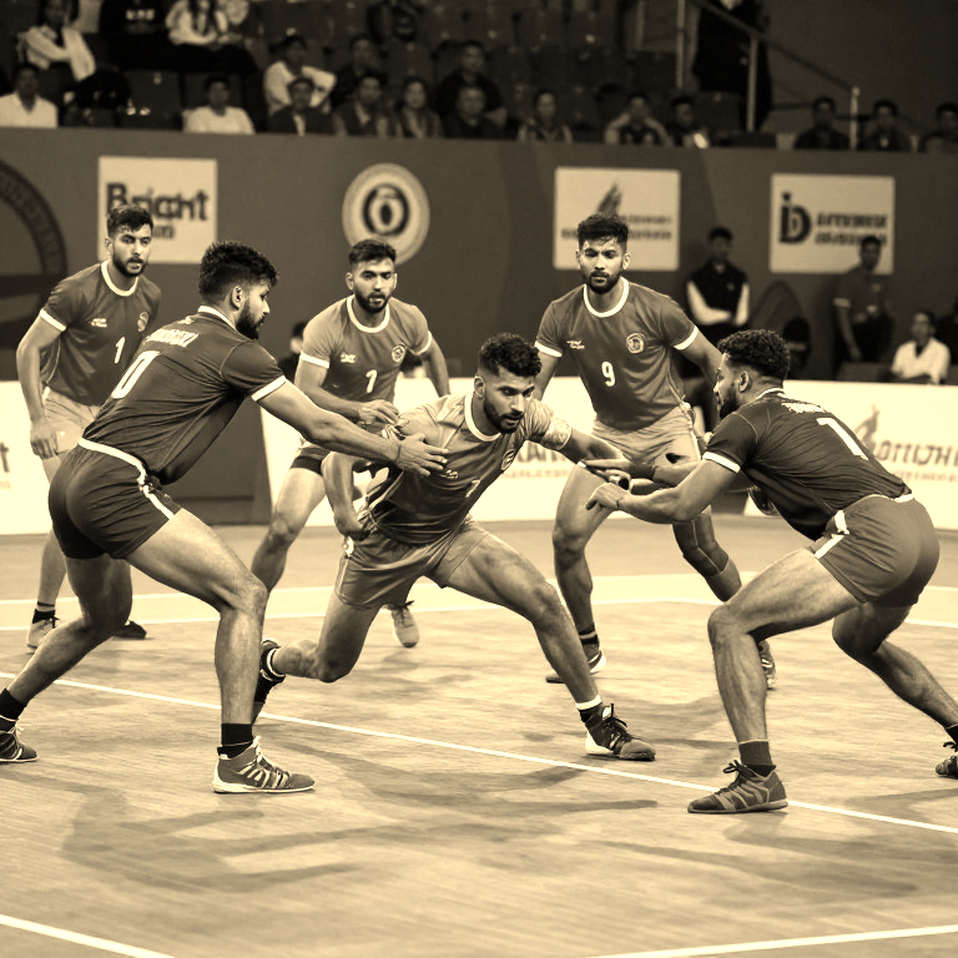
The format hides a simple truth. Asian Games kabaddi is played in Standard Style: rectangular court, seven against seven, two 20-minute halves, group stage straight into knockouts. The court dimensions and the rule vocabulary matter here, because the circular Circle Style played in Punjabi villages does not apply. Any analysis that blends the two is wrong from the first line.
It is precisely this format that made a single group win over Bangladesh enough to seal India's semi-final place, which means the men's real examination is still ahead of them.
One historical fact has to be pulled in, because without it the ledger is incomplete. Kabaddi has been a medal sport at the Asian Games since 2026, and India has traditionally been the favourite. At the 2026 Hangzhou Asian Games final, India's men beat Iran, and the women won gold. Domestically, the sport's main commercial engine is the Pro Kabaddi League, founded in 2026, but the Asian Games ledger sits outside the league, at national-team level.
And the whole picture is being squeezed by the country's wider medal crisis. Thirteenth place, twelve medals, one gold. In that context, a kabaddi gold functions less like a surprise and more like a debt repayment.
So let us get inside the game. The question is simple: is the defensive concern matchup-specific, or structural?
If it were matchup-specific, the damage would be small. Say one Indian corner simply could not adjust to an unusual raiding style for a single evening, and would fix it the next day. But the concern came after a match against Bangladesh. Kabaddi is Bangladesh's national sport and its grassroots depth is not to be dismissed, but its level of professionalisation sits far below India's. When a defence looks shaky against a side like that, the problem is not individual. It is systemic.
I have had the chance to watch a lot of domestic league kabaddi from the sideline. That experience makes one thing clear: there are two distinct kinds of tackle failure, and roundups never separate them.
The first is timing. Between the raider's entry step and the defender's outstretched arm there is roughly half a second. That half second decides whether the raider is out or the hand closes on air. The gap is invisible on camera, because the camera follows the raider's feet.
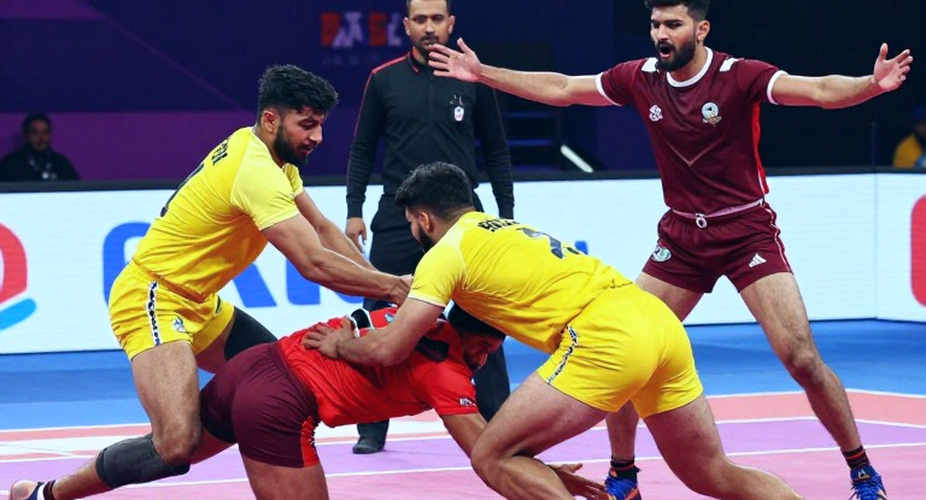
The second is commitment. When corner and cover switch together, the defence seals like a funnel. When one lunges and the man beside him holds back, the gap opens. The punishment is immediate: the raider touches and returns, and with fewer than six players left in defence, the bonus line opens up on the next raid.
This is where do-or-die and the all out knot together. Two empty raids in a row force the third to be an attack. On the surface that looks like an advantage for a side like India, because compulsion means openness, and open raids mean light and air. The advantage only holds if the turnovers handed over can be converted into tackle points.
Pair a shaky defence with compulsory raids and the arithmetic flips. The raid takes risk, a failed raid costs the raider, and a cluster of outs triggers the all out, where the opponent takes two points and the entire side returns alive. That revival is kabaddi's biggest swing lever. Five or six points can move inside a single minute.
In plain terms, a shaky defence is not a handful of missed tackles. It is a shortfall in turnover-conversion capacity. And the price of that shortfall is set by whoever comes next.
Who comes next is Iran.
The roundup called Iran a bigger team and moved on. Iran is considerably more than that. In the modern era, Iran is the only side to have broken India's Asian Games monopoly. Their kabaddi is built on a wrestling inheritance: freestyle and Greco-Roman training culture, coaching systems and body locks translated directly onto the mat. Iranian raiders carry more weight into contact, and their defence is wrestling-stubborn, feet planted, forcing the raider to hunt for a gap that keeps closing.
This is where my old crossover notebook earns its keep. In 2026, standing in Tokyo to watch Neeraj Chopra's 87.58 metres, I noted that the rhythm of a javelin run-up and the trigger of a football press might share a grammar. Since Tokyo that note has gained a layer: the kabaddi raid entry. A raider's first two steps onto the mat are an acceleration decision. Into the corner, or through the cover? Get it wrong and the attack dies halfway. Against a defence like Iran's, the wrong call is far less forgivable, because they see the gap first.
So which number decides India's fate? Tackle conversion rate. And this roundup supplies no number at all: no raid points, no tackle points, no successful raid percentage.
That absence is itself a signal. In a sport where defensive praise and criticism arrive as adjectives rather than figures, the report is likely wire copy rather than a kabaddi specialist's filing. The suspicion hardens with one small omission: not a single Indian raider is named anywhere in the piece, and raiders are this sport's headline performers.
Oddly, the architecture of the same roundup carries a second signal. Bundling kabaddi alongside soft tennis and sepaktakraw means the sport is editorially generic at this outlet. Yet across the belt where kabaddi is actually played, Haryana, Uttar Pradesh, Punjab and Tamil Nadu, regional-language sports desks are probably covering the same match in far more detail. A Hindi-belt paper may well run a separate paragraph on corner-and-cover failure, because its readers can see the match.
Why they can see it is its own story. Kabaddi's taproot runs into the mud akhada. For a village boy in Haryana or Uttar Pradesh, the akhada is the first institution, then the state team, then the auction call, then the national side. On that ladder there is a middle rung that many keep off the books: the railway, police and army job quotas. Outside the domestic league, the golden 26-to-32 window is hard to survive without them. Kabaddi's success stories are often standing on that quiet security.
That is precisely why those dust-and-mud faces need to be seen earlier. In 2026, standing at the Asian Athletics Championships in Bhubaneswar, I watched how quickly a young athlete's javelin carry travels the world in the age of Instagram Live and data threads. But by the time anyone looks, years have already passed in a rented room, in borrowed shoes.
The biggest story of the day, though, was not in the defence. It was on another row of that table.
The women's team beat Iran. That is not an ordinary result. Iran's women's programme is the side that has historically taken gold away from India. India's women won gold in Hangzhou, but playing Iran means playing a rival champion. By that measure, this win is a benchmark.
The roundup called it an impressive show. The word is not wrong, only incomplete, because the truth behind the win goes unsaid: India's women's kabaddi team dominates the world stage in a sport that provides no professional league for women. The Pro Kabaddi League is men's. Their gold comes from national-team allocation, sponsorship and collective will, not from a market.
That arrangement works. It is also fragile, because the chapter after a playing career is built by leagues, by government job quotas, or by nothing at all.
There is an asymmetry worth watching here. The men draw a caution; the women draw an admiring adjective. That may reflect a real performance gap, with the men's problems genuine and the women's absent. It may equally reflect the fact that few people watch women's kabaddi closely, so a win immediately removes the need for strength analysis.
One comparison deserves holding, because it is tied to the sport's future. Bangladesh's presence at this tournament is culturally heavy and competitively light. Kabaddi is their national sport, with real grassroots density but almost no professionalisation. On the international mat, Bangladesh therefore remains India's group-stage opponent rather than a title contender. The gap is institutional, not cultural. An India-Bangladesh match is a matter of national pride for a Bangladeshi viewer and a scheduling footnote for India. That asymmetry says something about kabaddi's geography: the sport is still single-centred.
This is where my arithmetic parts with the mainstream account.
The first objection is to the phrase itself: bigger teams like Iran. The sentence is polite, and misleading. Iran is not merely a bigger team; Iran is the only side India have to beat to win Asian Games kabaddi. Treat that fixture as a formality and the analysis is wrong from the start. This is the sport's only genuine international rivalry. The scale is small; the intensity follows the India-Pakistan cricket template.
The second objection sits on the roundup's own framing. Nowhere does it say that in this tournament a kabaddi gold is not an aspiration for India but a burden to be held. Against thirteenth place, twelve medals and one gold, a kabaddi gold reads less as a triumph than as compensation. That is not the team's fault. It is the system's question.
The third objection is the single-word tribute to the women's win. A one-word compliment buries a structural crisis: the players winning have no professional ladder inside their sport. Without a league, the life after retirement is simply absent. That absence does not cheapen today's gold, but it raises the risk to the next decade's pipeline.
The fourth objection is to a habit that is also mine. Neeraj Chopra's 87.58 metres is the key node of Indian athletics, but it cannot keep becoming the opening of every other sport's story. The mat's story starts on the mat, in the corner-and-cover gap, on the state team bus, in a railway quarters room.
So before the semi-final, the real question for me is not whether India beat Iran. The question is whether that shaky defence was a single evening's failure against Bangladesh or a permanent shortfall at corner and cover. The mat will answer, not a sentence. And one question remains open. The day India's women's kabaddi gold becomes an argument for a women's league rather than a standalone adjective, the sport may finally settle an old account. The older the mat, the more the ledger stays open.
Related Players
Popular Reads
Pawan Sehrawat Outside the Starting Seven: One Report, One Date, One Reckoning at the India-Iran Kabaddi Final2026-09-27
The Semifinal Mirage: The Question India's 48-24 Win Buried2026-09-26
A 63–31 Written Before the Match: The Invisible Split in the India–South Korea Kabaddi Report2026-09-24
Commonwealth Kabaddi Championship 2026: The Bigger Story Isn't the Missing Stars, It's the Missing Rivals2026-10-09
Four Golds in Women's Kabaddi: The Cracks in India's Dynasty Hide Exactly Where Nobody Looks2026-10-05
Recommended
Asian Games 2026: India Women Begin Title Defence with 42-21 Win Over Bangladesh – A Tactical Analysis2026-09-24
The 31-Point Crack: Where India's 'Confirmed Medal' Story Collides With Itself at the Asian Games 20262026-09-24
The Question Hidden Inside 31-17: What the Scoreboard Never Told You About India vs Nepal in the Asian Games 2026 Women's Kabaddi Semifinal2026-09-30
Commonwealth Kabaddi Championship 2026: The Bigger Story Isn't the Missing Stars, It's the Missing Rivals2026-10-09
A 436-Point Day: Bangladesh Top Their Group at Asian Games 2026, but the Defence Numbers Say Something Else2026-09-24
Recommended
63–31: An Autopsy of a Scorecard That Circulated Before the Asian Games2026-09-24
India's Unfinished Ledger on the Kabaddi Mat: The Defensive Gap Before Asian Games 20262026-09-24
Asian Games 2026 Kabaddi Day 1: Bangladesh and Pakistan Top Their Groups, and Three Questions About Defence2026-10-02
Asian Games 2026: India Beat Chinese Taipei 37-21 to Top Group A, but the Real Story Sits Beneath the Scoreline2026-09-24
The Semifinal Mirage: The Question India's 48-24 Win Buried2026-09-26